How Can AI Help Me Generate Ideas?
Creativity is scarce in direction, standards, and tradeoffs
Overview
AI excels at divergence, but humans define the search space, criteria, and final tradeoffs.
Key Points
- Creativity is defining the search space and criteria, not just producing ideas
- AI is strong at divergence but weak at value tradeoffs
- Two-step process: diverge first, converge later
Use Cases
- Brainstorm with AI, then apply clear filters
- Map exploration directions for products/projects
- Align teams on what “good” looks like
Common Pitfalls
- Chasing novelty over usability
- Delegating value choices to AI
- Search space too wide, leading to noise
🧠 How Can AI Help Me Generate Ideas?
— When AI can generate anything, what is creativity actually scarce in?
1) Rescue “creativity” from a common misunderstanding
Many people think creativity means “coming up with a new idea.” In the AI era, that definition collapses—new ideas have become cheap. One prompt and AI can give you 50.
Real creativity needs at least two conditions:
- Novel: not trapped in obvious patterns
- Useful: works under real‑world constraints and creates value
AI is strong at “novel,” but often unstable at “useful.” The reason is not intelligence—it’s that useful is not a language problem. It is a mix of goals, constraints, values, and consequences.
2) The essence of creativity: not output, but building the search space
At a deeper level, creativity is not the answer—it is deciding where to look for the answer.
We can think of creativity as:
Constructing a search space and defining evaluation criteria.
- Search space too small → only mediocre solutions
- Search space too large → noisy ideas that cannot be implemented
- Criteria unclear → more output just means more pile‑up
That is why “AI is great at generating” does not automatically make you more creative. AI can run fast inside the space, but it does not know how to define the space or the criteria.
3) AI’s boundary: great at exploration, weak at direction
From a cognitive division‑of‑labor view, AI excels at one thing: divergent search and recombination (rapidly assembling patterns into candidate options).
But the scarce part of creativity is not divergence—it is two things:
- Objective function (What matters): what counts as “good”? what is the bottom line?
- Value tradeoffs: how do we choose between conflicting goals?
These depend on:
- Real‑world context (who you are, resources, limits, risks)
- Value judgment (what you are willing to trade)
- Consequence awareness (who bears the cost if wrong)
AI does not “bear costs,” so it cannot naturally own tradeoffs. It can give you many “seemingly good” options, but it cannot tell you which one is worth the bet.
4) A deeper point: creativity is a structure of responsibility
Many people think creativity is free. In reality, meaningful creativity is shaped by constraints. An idea has value because it answers three kinds of constraints:
- Factual constraints: does the world allow it?
- System constraints: what ripple effects happen in processes/organizations/society?
- Responsibility constraints: who bears the cost of failure?
AI can help analyze the first two, but it can never replace the third. So in the AI era, creativity increasingly looks like advanced judgment:
Not “anything goes,” but proposing directions worth pursuing under constraints.
5) How AI actually helps creativity: the two‑phase approach
The deep use is not asking AI to “give ideas,” but splitting creativity into two stages:
Stage A: Diverge — let AI expand the space Ask AI to broaden possibilities, list alternatives, and propose different hypotheses.
Stage B: Converge — humans make tradeoffs Use your objectives and responsibility boundaries to filter, restructure, and choose direction.
In short:
- AI helps “find faster”
- Humans decide “what to find + what to choose + what to take responsibility for”
That is the essence of creative collaboration in the AI era.
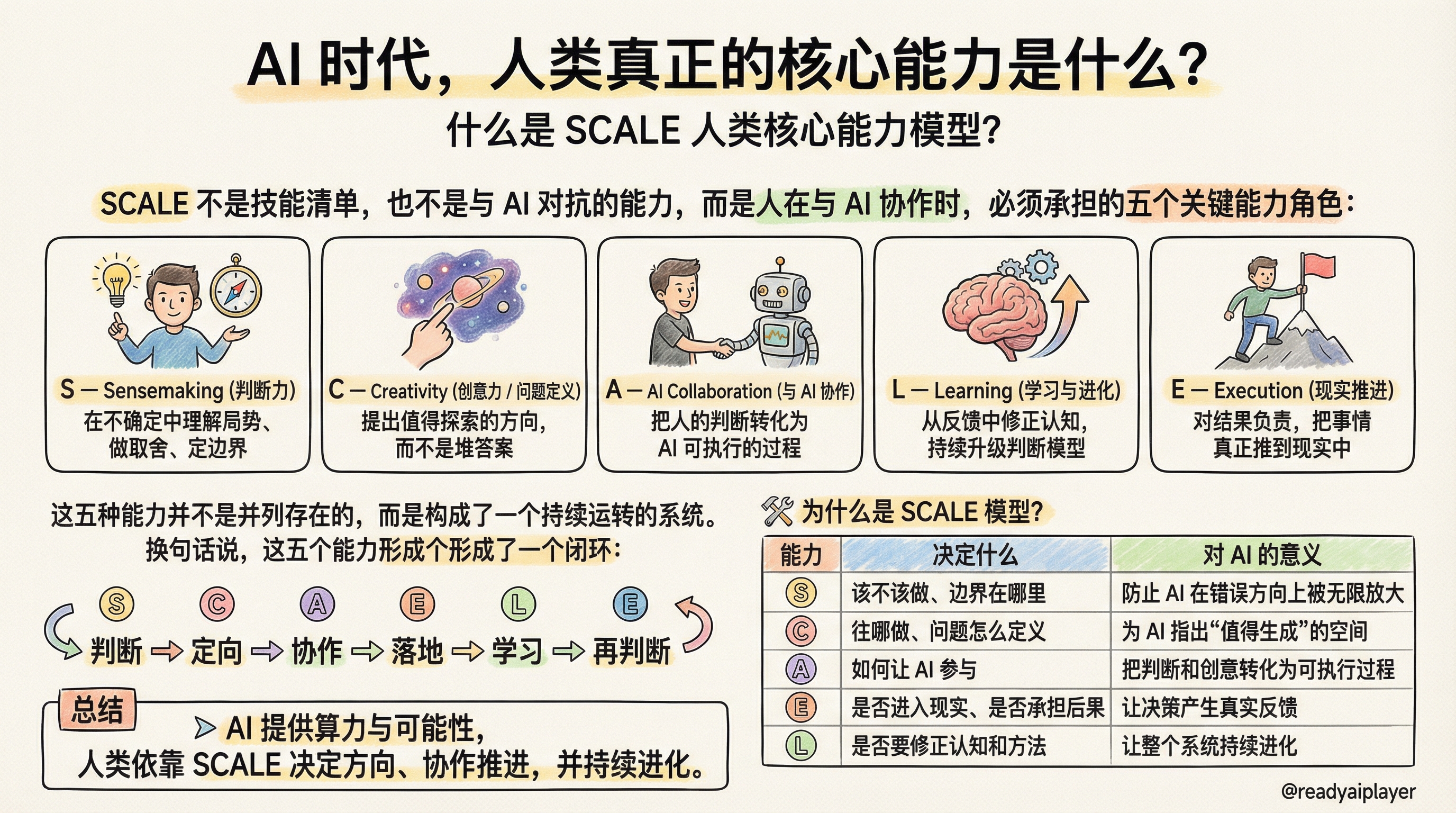
6) Back to SCALE: C is not “inspiration,” but direction‑setting power
In the SCALE framework, C can be defined more precisely:
C (Creativity) = Propose directions worth exploring under uncertainty and constraints, and set evaluation criteria.
It is not about competing with AI on generation, but about:
- Defining the search space
- Defining evaluation standards
- Defining tradeoff rules
These are exactly the places where AI lacks an internal reason.
✅ Summary
AI has made “generation” cheap, so the scarcity has shifted:
- Before: Ideas themselves
- Now: Direction, standards, tradeoffs, and responsibility
Therefore, the best way AI makes you more creative is not “more output,” but:
Let AI expand possibilities; let humans decide meaning.